Buying a commercial matcha stone mill is not simply a matter of choosing the machine with the highest output or the lowest price.
For cafés, tea houses, matcha brands, tea processors, and other professional buyers, the right grinding equipment needs to balance grinding performance, consistency, capacity, temperature management, machine construction, electrical configuration, maintenance, and long-term technical support.
A commercial matcha stone mill is a professional piece of processing equipment. Before placing an order, buyers should understand what actually matters and which specifications deserve the most attention.
This guide explains 10 important factors to consider when choosing a commercial matcha stone mill.
1. Consider the Grinding Stone Material
The grinding stones are one of the most important components of a stone mill.
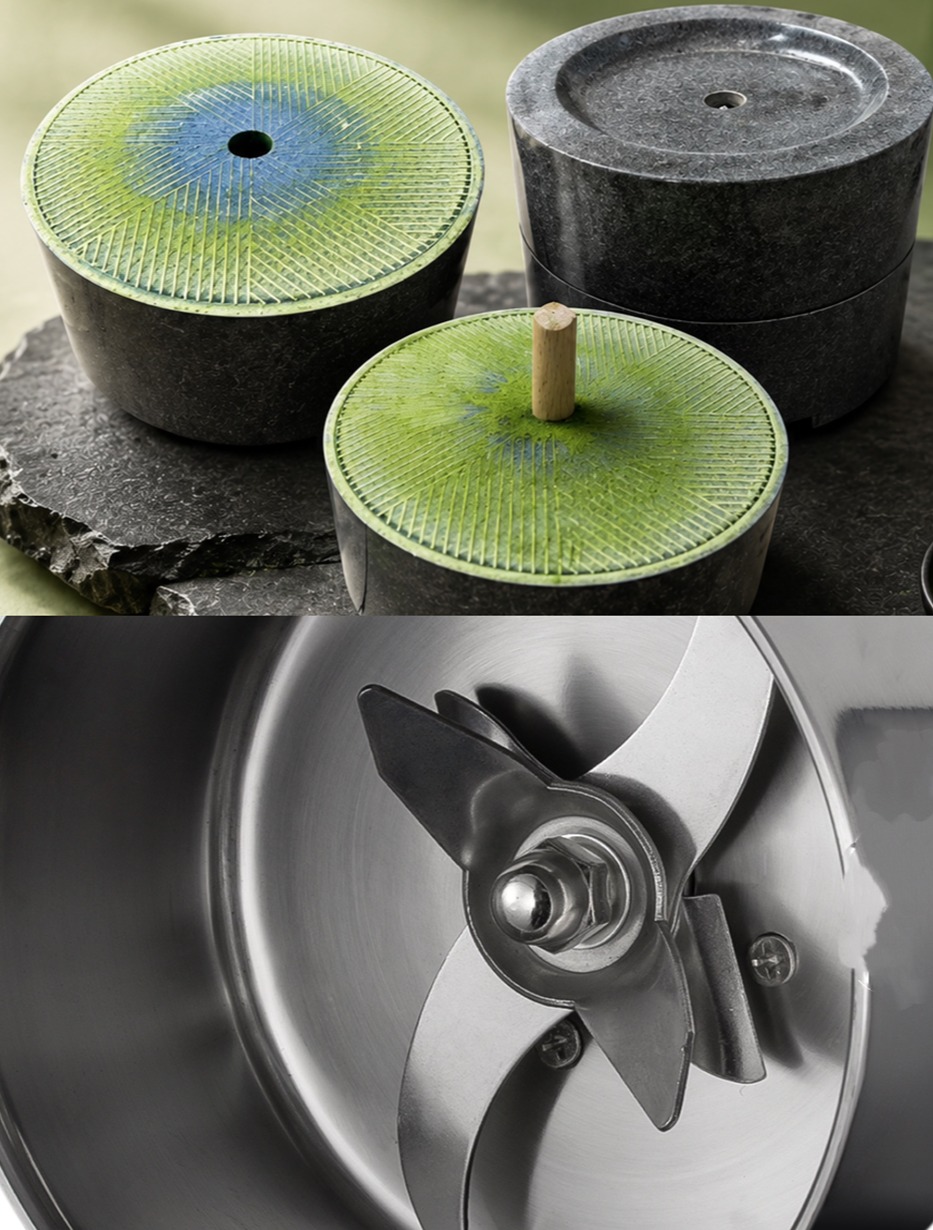
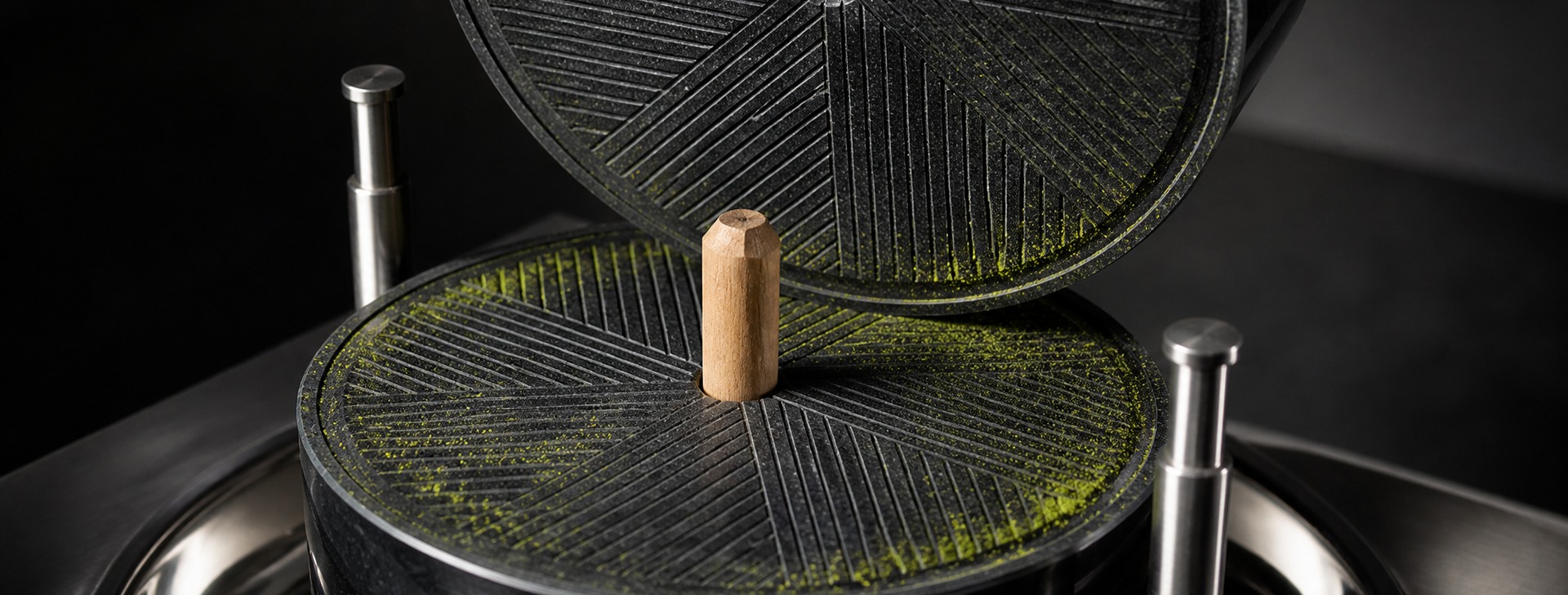
Natural granite is traditionally used for matcha stone grinding because it provides a hard, durable grinding surface and is suitable for producing very fine powder through controlled grinding.
However, not all stone mills use the same stone material or construction.
When comparing machines, buyers should ask:
- What type of stone is used?
- Is it natural granite or another material?
- What is the size of the grinding stones?
- How is the stone surface maintained?
- Is the stone designed specifically for fine matcha grinding?
The stone itself is only part of the equation. The grinding result also depends on the stone geometry, rotational speed, feeding method, and machine design.
For commercial applications, buyers should evaluate the entire grinding system rather than focusing on the material name alone.
Learn more:
Why Is Natural Granite Used for Matcha Stone Mills?
2. Pay Attention to Grinding Speed
Grinding speed has a direct relationship with the way the machine processes tea leaves.
A higher rotational speed may increase throughput, but speed is not necessarily the most important objective when producing premium matcha.
Matcha stone grinding is generally based on controlled and relatively slow grinding.
The goal is not simply to maximize RPM. Instead, the machine should provide a balanced combination of:
- Controlled grinding
- Stable powder quality
- Appropriate grinding temperature
- Consistent feeding
- Suitable production capacity
For example, the JUNZHENG JZMY06 operates at approximately 30–40 rpm, with adjustable speed depending on the operating requirements.
This relatively slow grinding approach is designed around controlled processing rather than high-speed pulverization.
The right speed ultimately depends on the machine structure, grinding stones, raw material, desired particle size, and application.
3. Check the Particle Size and Fineness
Particle size is one of the most important specifications when evaluating a matcha grinding machine.
Matcha is expected to be an extremely fine powder, especially when it is intended for direct beverage preparation.
However, buyers should be careful with marketing terms such as:
“Ultra-fine powder”
or
“Super-fine grinding.”
These descriptions are not enough by themselves.
A professional buyer should ask the manufacturer:
- What particle size can the machine achieve?
- How is fineness measured?
- Is the result consistent during operation?
- What type of tea material is used for testing?
- Is the machine designed specifically for matcha?
The JUNZHENG JZMY06 is designed for fine matcha grinding and can achieve a fineness of approximately ≤11 μm under suitable operating conditions.
Actual grinding results can vary depending on the raw material, preparation, feeding rate, stone condition, and operating parameters.
For commercial buyers, the important point is to understand both the stated specification and the conditions under which that specification is achieved.
4. Match the Machine Capacity to Your Business
Not every commercial buyer needs a high-output industrial grinding system.
A matcha café may only require small-batch production, while a tea processor or matcha brand may have significantly higher daily demand.
Before choosing a machine, estimate:
- Daily matcha consumption
- Required batch size
- Number of operating hours
- Peak production periods
- Future growth
- Whether the machine will be used for testing or continuous production
For example:
| Business Type | Main Consideration |
|---|---|
| Matcha Café | Small-batch daily production |
| Tea House | Flexible and consistent grinding |
| Matcha Brand | Stable production and repeatability |
| Tea Processor | Higher capacity and continuous operation |
| Distributor | Product reliability and market positioning |
The JZMY06 is designed for commercial small-batch matcha grinding, with an output of approximately 30–40 g/hour.
This type of capacity can be particularly suitable for businesses that prioritize controlled production and premium product positioning rather than mass high-speed powder production.
The key question is not:
“What machine has the highest capacity?”
It is:
“What capacity actually fits my business?”
5. Understand Grinding Temperature
Temperature is another important consideration in matcha grinding.
Grinding generates friction, and excessive heat can become an important factor when processing finely ground tea powder.
This is one reason why controlled, low-speed stone grinding has remained important in traditional matcha production.
When comparing machines, buyers should look beyond statements such as “low temperature” and understand how the machine achieves controlled grinding conditions.
Important factors include:
- Grinding speed
- Stone design
- Grinding pressure
- Feeding rate
- Operating environment
- Continuous operating time
The JUNZHENG JZMY06 is designed for low-temperature grinding and typically operates at below 40°C under suitable conditions.
This does not mean that temperature is automatically fixed at one number during every operation. Actual temperature can vary with operating conditions, raw material, ambient temperature, and grinding time.
The important principle is controlled grinding rather than simply adding a cooling system to a high-speed grinder.
Learn more:
Why Does Low-Temperature Grinding Matter for Matcha?
6. Evaluate the Machine Construction and Materials
A commercial matcha mill needs to withstand regular operation.
For professional buyers, machine construction can be just as important as grinding performance.
A commercial machine should be designed with practical considerations such as:
- Structural stability
- Food-contact materials
- Easy operation
- Cleaning access
- Operator safety
- Long-term durability
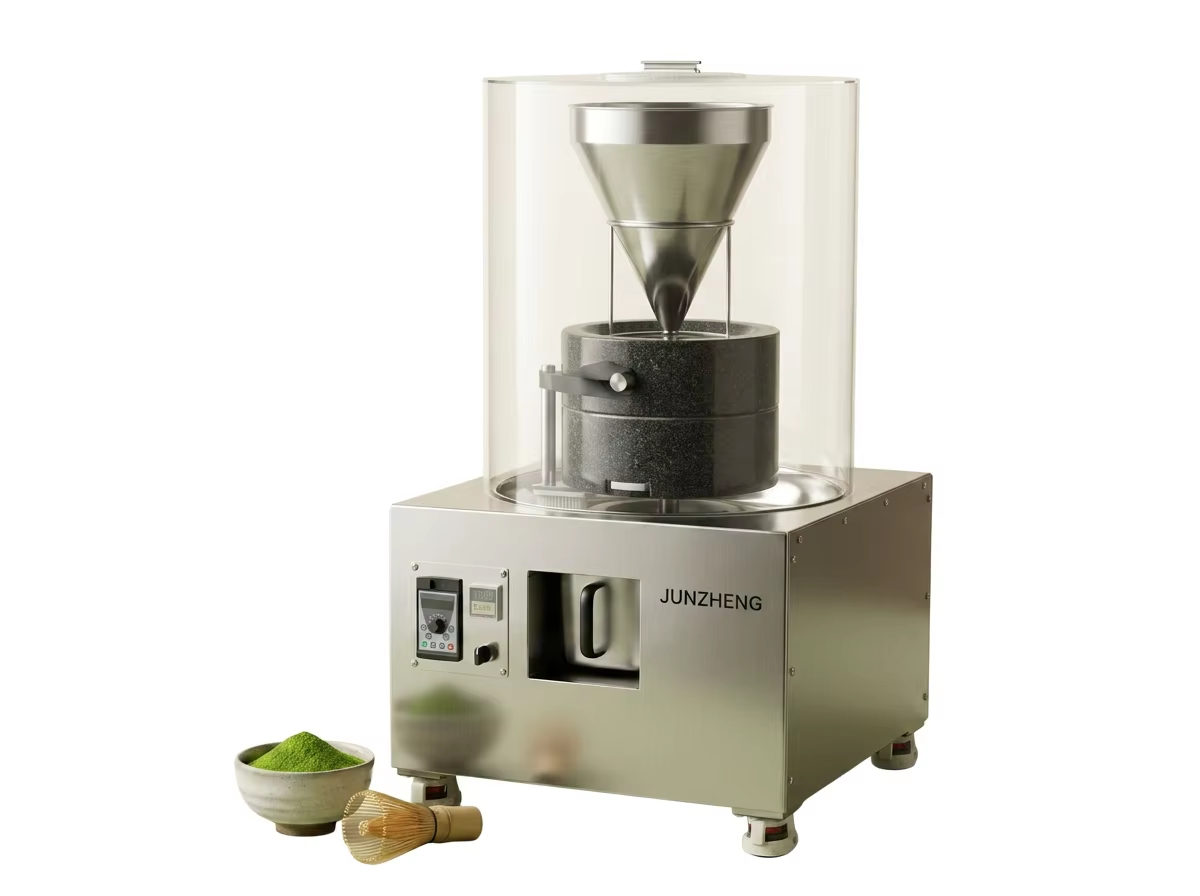
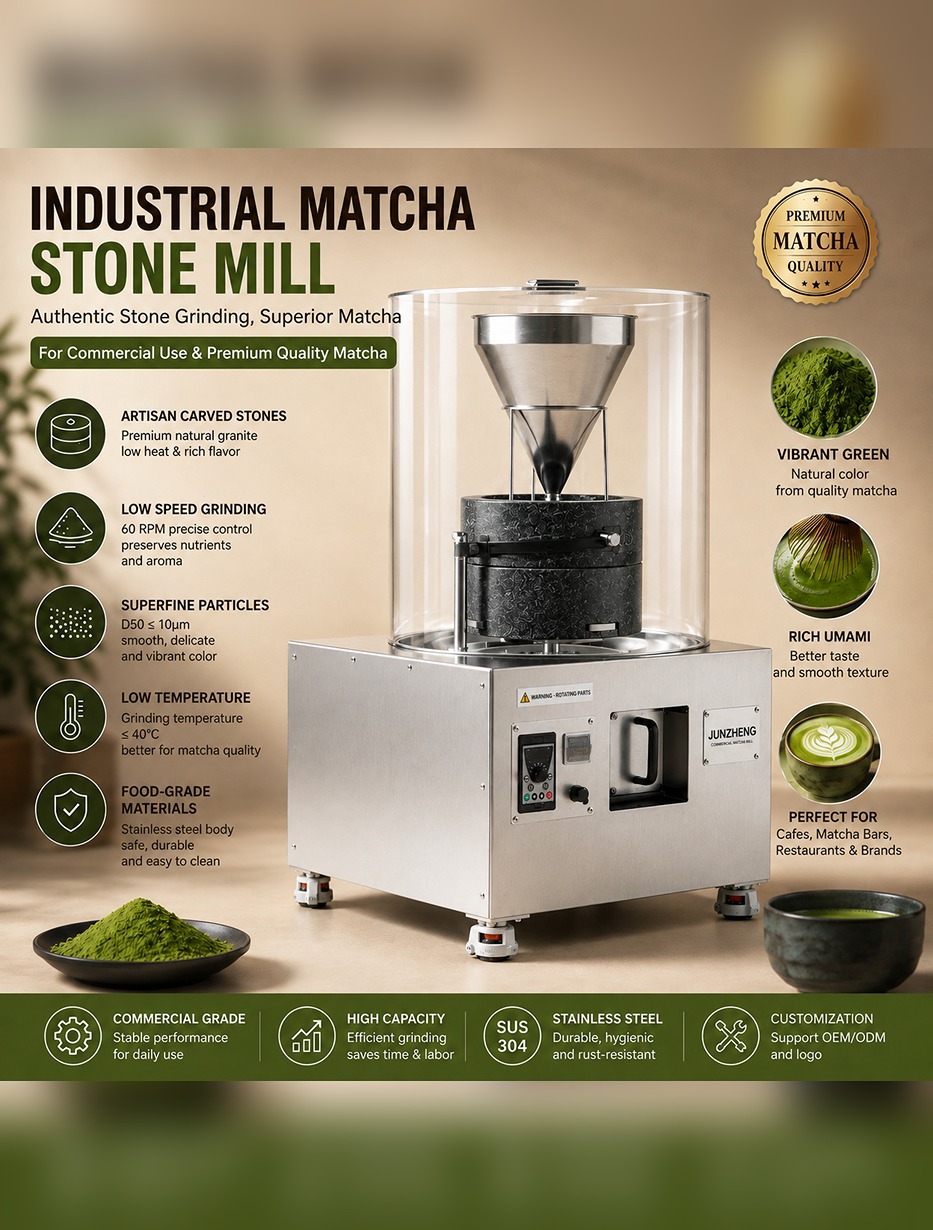
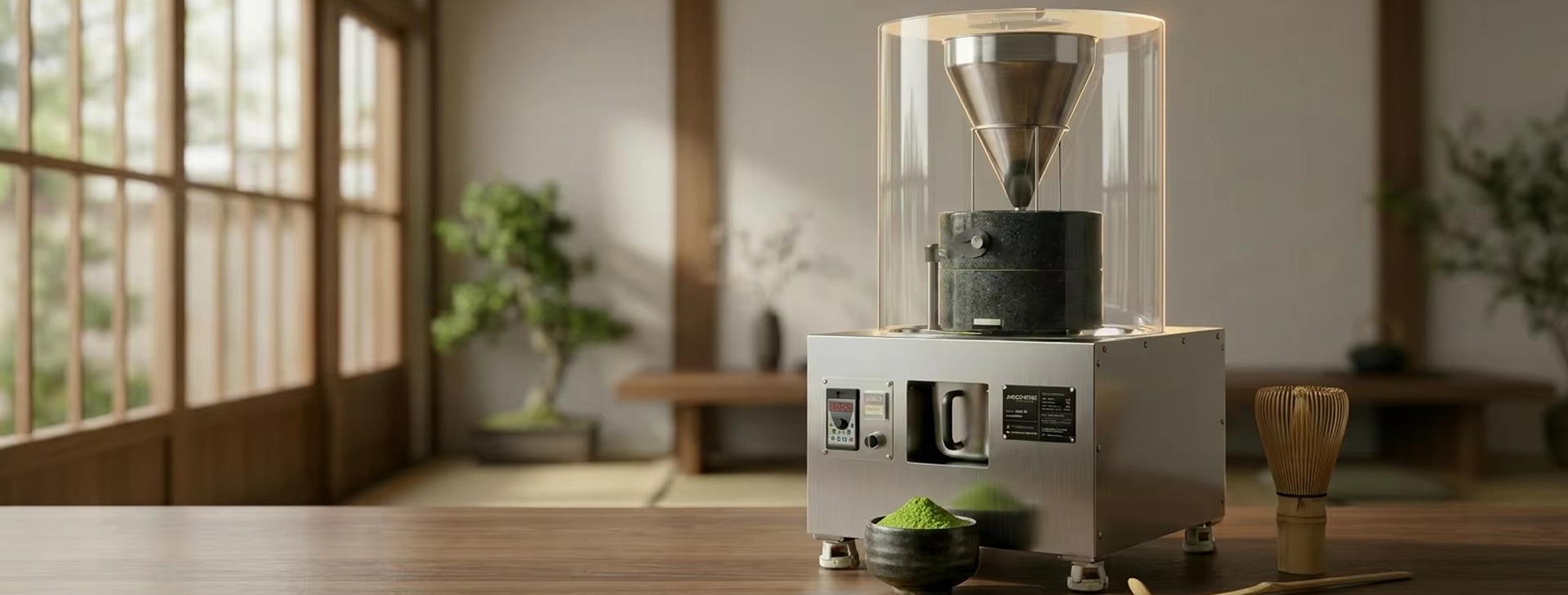
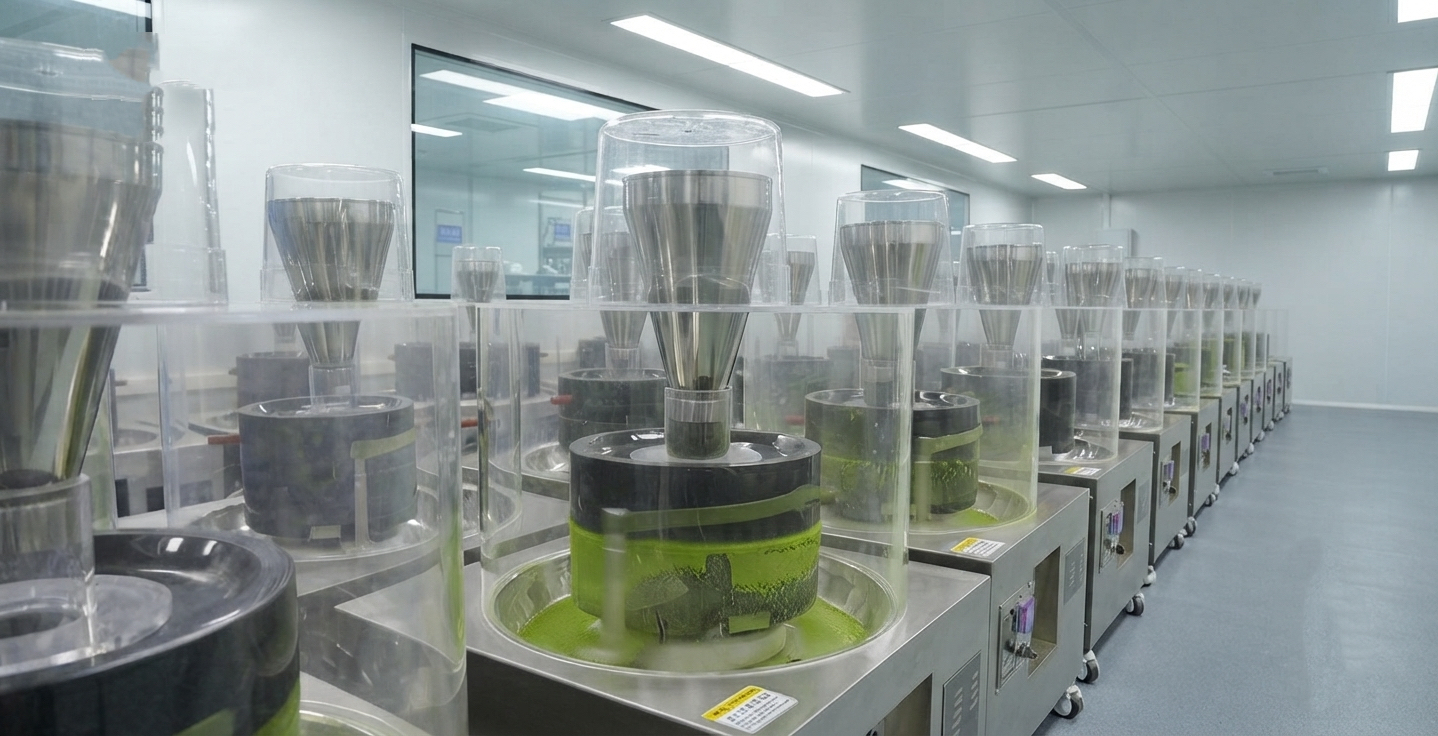
The JUNZHENG JZMY06 uses a stainless-steel commercial body, a natural black granite grinding system, a stainless-steel feeding hopper, and a transparent acrylic protective cover.
The machine is also designed for practical commercial use, including lockable casters for positioning and operation.
A commercial matcha mill is not simply a larger household grinder.
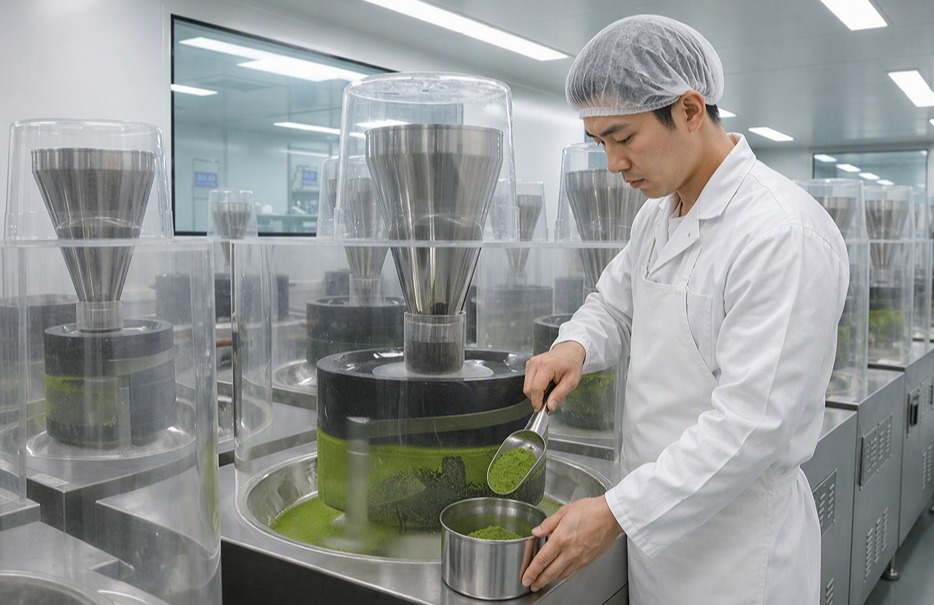
Its design should reflect the working environment of cafés, tea businesses, production facilities, and professional processing operations.
7. Check Voltage, Frequency, and Electrical Configuration
Electrical compatibility is often overlooked during equipment purchasing.
A machine may perform well technically but still create problems if the electrical configuration does not match the buyer’s location.
Before ordering, confirm:
- Voltage
- Frequency
- Phase
- Motor power
- Plug type
- Local electrical requirements
For example, the standard JZMY06 configuration is:
- Voltage: 220V
- Frequency: 50Hz
- Phase: Single phase
- Motor power: 400W
International buyers should always confirm the required electrical configuration before placing an order.
This is especially important for distributors and commercial buyers purchasing machines for different countries or regions.
When necessary, buyers can also discuss electrical and configuration requirements with the manufacturer before production.
8. Consider Cleaning and Daily Operation
Grinding performance is important, but so is what happens after grinding.
For a café or commercial kitchen, equipment may be cleaned and operated every day.
A machine that is difficult to clean or maintain can create additional labor costs over time.
Before purchasing, consider:
- How easily can the operator access the grinding area?
- How is residual powder removed?
- How often does routine cleaning need to be performed?
- Is the machine convenient for daily use?
- Can operators perform basic maintenance safely?
For commercial users, cleaning efficiency can be almost as important as grinding performance.
A machine should fit naturally into the daily workflow rather than becoming an additional operational burden.
9. Ask About Customization and OEM Requirements
Different markets and businesses may have different equipment requirements.
A café operator, private-label brand, tea processor, and distributor may not need exactly the same configuration.
Depending on the project, buyers may need to discuss:
- Voltage and plug configuration
- Product labeling
- Branding
- Packaging
- Cabinet appearance
- Application-specific configuration
- OEM or private-label requirements
However, customization should have a practical purpose.
The objective is not simply to add more features. Good customization should solve a genuine requirement related to the buyer’s market, application, branding, or operating environment.
For distributors and professional matcha brands, this can be especially valuable when building a differentiated equipment offering.
10. Consider Technical Support and After-Sales Service
A commercial machine is not just a product purchase.
It is part of a long-term production system.
Before placing an order, buyers should understand what technical support the manufacturer can provide.
Important questions include:
- Is the machine tested before shipment?
- Is operating guidance provided?
- Is technical support available after delivery?
- Are replacement parts available?
- Can the manufacturer help troubleshoot operating problems?
- Can the supplier support customers in different countries?
For international buyers, communication is particularly important.
A reliable manufacturer should be able to provide support before, during, and after the purchase.
This can include production testing, operating guidance, technical communication, troubleshooting assistance, and replacement-part support.
The machine price is only one part of the overall purchasing decision.
Commercial Matcha Stone Mill Buying Checklist
Before purchasing a commercial matcha stone mill, buyers can use the following checklist:
- Grinding stone material
- Grinding stone design
- Grinding speed
- Particle size
- Production capacity
- Grinding temperature
- Motor power
- Voltage and frequency
- Machine construction
- Cleaning requirements
- Maintenance requirements
- Warranty and spare parts
- OEM or customization options
- Technical support
A supplier that can answer these questions clearly is generally easier to evaluate than a supplier that only provides a price and a product photo.
Should Price Be the First Factor?
Not necessarily.
Price is important, but it should not be the only criterion when purchasing commercial matcha processing equipment.
The real cost of a machine can also include:
- Production efficiency
- Grinding consistency
- Labor requirements
- Cleaning time
- Maintenance
- Downtime
- Spare parts
- Technical support
- Product positioning
- Shipping and installation considerations
A machine with a lower purchase price may not always be the most economical choice over the long term.
This is particularly important for businesses that use matcha equipment every day or depend on consistent powder quality for their products.
For professional buyers, the better question is:
What machine provides the right balance of performance, reliability, capacity, and long-term value for my application?
Why Choose JUNZHENG for Commercial Matcha Grinding?
JUNZHENG focuses on commercial matcha grinding equipment for cafés, tea businesses, matcha brands, professional processors, and international buyers.
The JZMY06 commercial matcha stone mill combines a natural black granite grinding system with a modern commercial machine structure.
JZMY06 Key Specifications
Grinding stones: Natural black granite
Motor: 400W
Grinding speed: Approximately 30–40 rpm
Capacity: Approximately 30–40 g/hour
Fineness: Approximately ≤11 μm under suitable operating conditions
Grinding temperature: Designed for low-temperature grinding, typically below 40°C under suitable conditions
Voltage: 220V / 50Hz
Phase: Single phase
Machine body: Stainless steel
Rather than treating a matcha stone mill as a generic powder grinder, JUNZHENG focuses on the requirements of professional matcha grinding and commercial applications.
Final Thoughts
Choosing the right commercial matcha stone mill requires more than comparing product prices.
The grinding stones, grinding speed, particle size, capacity, temperature, construction, electrical configuration, cleaning requirements, customization options, and technical support should all be evaluated together.
For a small café, the priorities may be compact commercial production and ease of operation.
For a matcha brand or processor, consistency, capacity, and long-term reliability may become more important.
The best machine is therefore not necessarily the most powerful or the least expensive one.
It is the machine that matches your actual application, production needs, and long-term business goals.
Looking for the right commercial matcha stone mill for your business? Contact JUNZHENG to discuss your application, required capacity, and machine configuration.