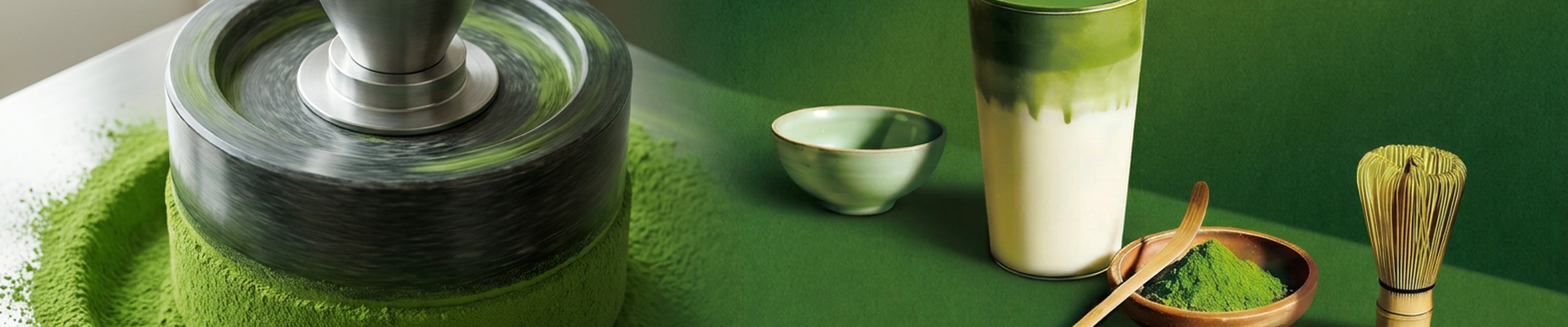
Many people know matcha as a bright green powder used in tea, lattes, desserts, and modern beverages.
But matcha is not simply ordinary green tea that has been ground into powder.
Authentic matcha production begins with specially cultivated and processed tea leaves known as tencha. The journey from tea plant to finished matcha involves cultivation, shading, harvesting, steaming, drying, processing, and finally grinding the prepared tea material into a fine powder.
Understanding this process also helps explain why the grinding stage—and the equipment used for it—matters so much.
This guide explains how matcha is made from tencha and where stone grinding fits into the overall production process.
From Tea Plant to Matcha: The Basic Process
A simplified matcha production process can be understood as:
Tea Plant → Shading → Harvesting → Steaming → Drying → Tencha → Grinding → Matcha Powder
The exact production methods can vary by region, producer, tea cultivar, and production scale.
However, the key principle remains the same: matcha begins with tea material specifically prepared for fine-powder production.
Japan’s Ministry of Agriculture, Forestry and Fisheries describes matcha as a fine powdered green tea made from young tea leaves that are shaded, steamed, processed into tencha by drying without the conventional rolling process, and then traditionally ground with a stone mill.
1. What Is Tencha?
Tencha is the specially processed tea material used to make matcha.
This is one of the most important concepts to understand.
Tencha is not simply ordinary dried green tea. Its production follows a different processing route that prepares the leaves for subsequent grinding.
The leaves are grown under shading, harvested, steamed to stop oxidation, and then dried without the rolling process commonly used for other Japanese green teas. Further processing can separate stems and other unwanted material from the leaf material before it is used for matcha production.
This means that when a stone mill receives tencha, the machine is not starting with fresh tea leaves.
It is processing a carefully prepared tea material that has already gone through several stages of production.
That distinction is important when evaluating matcha grinding equipment.
2. How Is Tea Grown for Matcha?
The production of matcha begins long before the grinding stage.
Tea plants used for matcha are commonly shaded before harvesting. Shading reduces direct exposure to sunlight and changes the growth environment of the tea leaves.
Japanese sources describe shading as an important part of producing tea intended for matcha, with the process associated with characteristics such as reduced astringency and stronger umami.
The exact shading method and duration can vary between growing regions and producers.
For a matcha producer, this is an important reminder:
High-quality matcha starts with the raw material, not the grinding machine.
A grinding machine can process tencha into fine powder, but it cannot compensate for unsuitable or poorly prepared tea material.
3. Harvesting and Selecting the Tea Leaves
After the appropriate growing period, the tea leaves are harvested.
The quality of the raw material can depend on several factors, including:
- Cultivar
- Growing conditions
- Shading practices
- Harvest timing
- Leaf quality
- Processing methods
The harvested leaves then move quickly into processing.
This is important because the final characteristics of matcha are influenced by the entire production chain rather than by grinding alone.
For commercial matcha businesses, it is useful to think about the process as a system:
Raw Material + Tea Processing + Grinding + Handling = Finished Matcha
This is also why professional matcha equipment should be evaluated within the context of the overall production process.
4. Steaming: An Important Step After Harvest
Fresh tea leaves must be processed soon after harvesting.
In Japanese green tea production, steaming is used as part of the process to stop enzymatic oxidation and preserve the green character of the leaves.
For tencha production, the freshly harvested leaves are steamed and then proceed through cooling and drying processes.
The objective is not simply to “dry the leaves.”
The leaves must be transformed into a stable tea material that can later be further processed and ground.
This stage therefore connects the agricultural part of matcha production with the processing stage.
5. Drying and Producing Tencha
After steaming, the leaves are dried through a process specifically designed for tencha production.
Unlike many other Japanese teas, tencha is not rolled into the familiar needle-like or twisted shapes associated with sencha.
Instead, the tea is dried in a form suitable for further processing into matcha.
After drying, finishing operations can include separating stems and other material from the leaf portion. Japanese agricultural authorities describe modern tencha production lines as including steaming, drying, stem-cutting, and separation processes before the finished tencha is sent onward for grinding.
At this stage, the tea has become tencha—the raw material from which matcha powder can be produced.
6. From Tencha to Matcha Powder
Now comes the stage most closely associated with a matcha stone mill.
The basic concept is simple:
Tencha → Controlled Grinding → Fine Matcha Powder
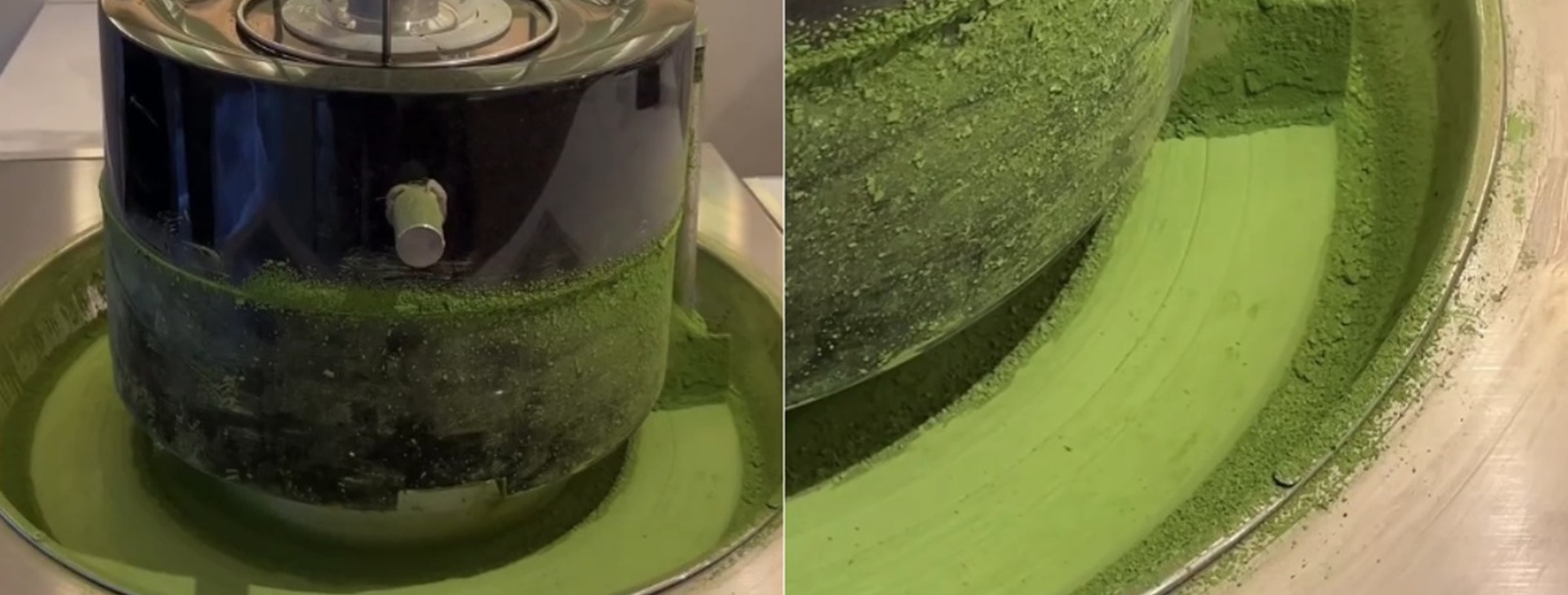
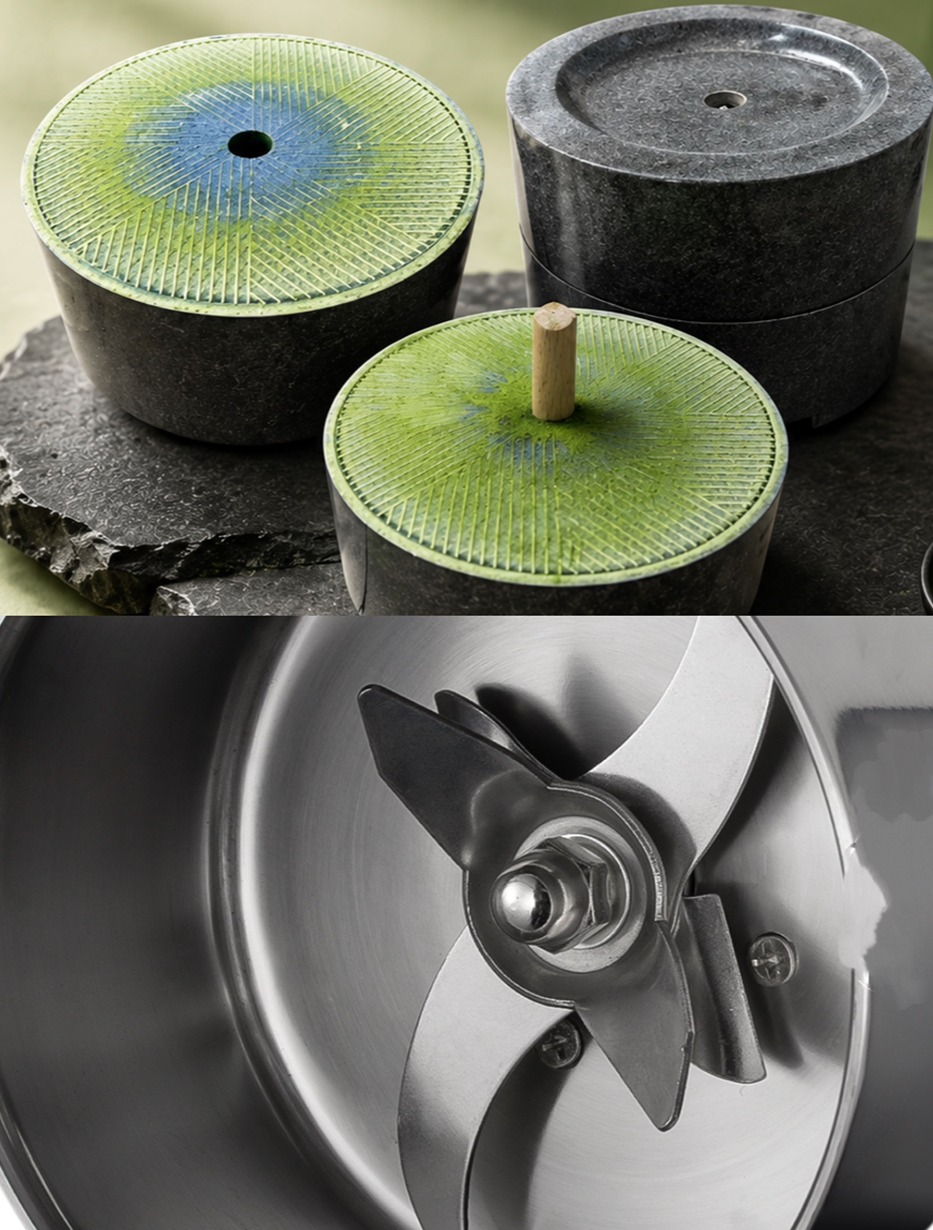
Traditional matcha production uses a stone mill to gradually reduce tencha into extremely fine particles.
The grinding process is fundamentally different from simply chopping tea leaves with a high-speed blade.
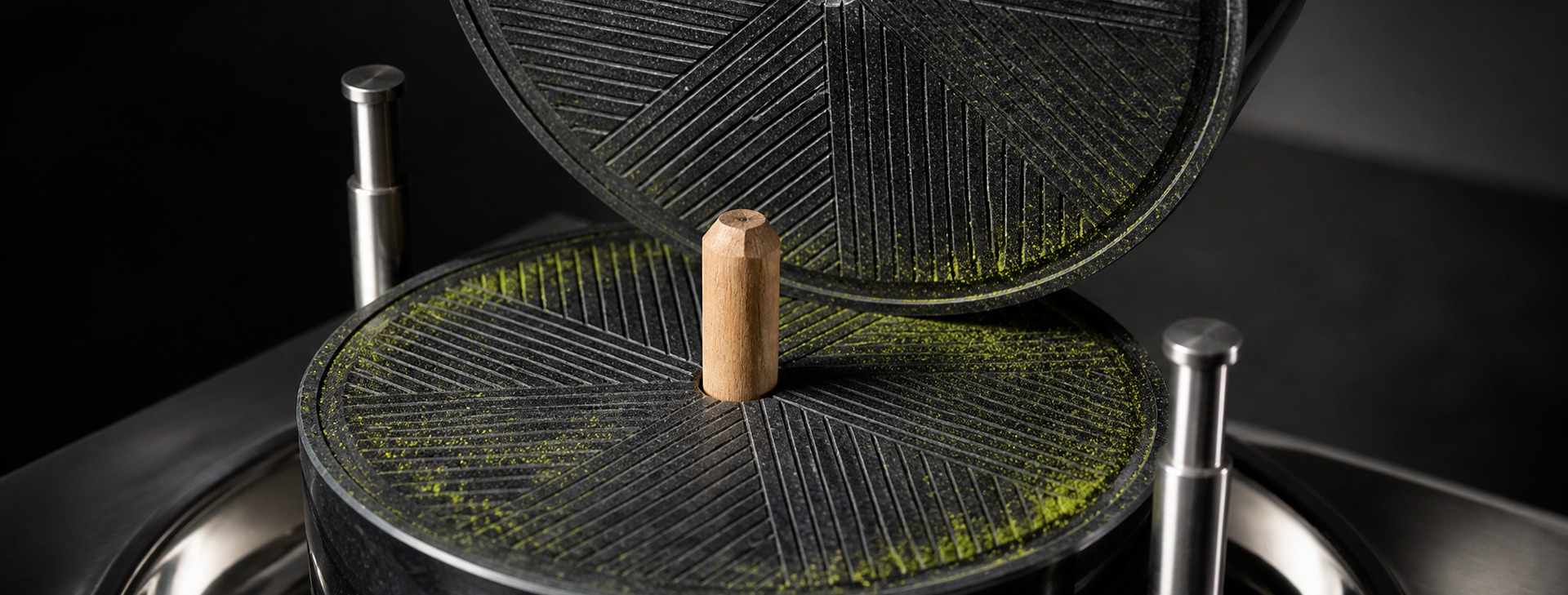
A stone mill uses two grinding surfaces moving against each other while the tea material is gradually reduced.
This controlled process is one reason stone grinding has historically remained closely associated with premium matcha production.
Learn more:
[What Is a Matcha Stone Mill? A Complete Guide to Traditional Stone Grinding]
and
[How Does a Matcha Stone Mill Work? A Complete Guide to the Grinding Process]
7. Why Is Matcha Traditionally Stone Ground?
Stone grinding is not simply a historical tradition.
It also reflects the physical requirements of producing an exceptionally fine tea powder.
A well-designed stone grinding system can provide:
- Controlled reduction of tea material
- Gradual grinding
- Fine particle production
- Relatively low rotational speed
- A traditional grinding method associated with matcha
The grinding process also needs to be carefully controlled because excessive friction and heat can become important considerations when producing very fine tea powder.
This is why grinding speed, stone design, feeding rate, and operating conditions all matter.
Our previous articles explore these subjects in greater detail:
Why Is Natural Granite Used for Matcha Stone Mills?
Why Does Low-Temperature Grinding Matter for Matcha?
Stone Mill vs. Blade Grinder: Which Is Better for Matcha?
8. How Fine Is Matcha Powder?
One of the defining characteristics of matcha is its very fine particle size.
Japanese government material describes traditionally stone-ground matcha in the approximate range of 1–20 μm, while actual particle size can vary according to the raw material, grinding equipment, and measurement method.
This is why a commercial matcha grinding machine should not be evaluated simply by asking:
“How fast can it pulverize tea?”
A better question is:
Can it consistently produce the particle size required for the intended application?
For professional buyers, relevant considerations include:
- Grinding fineness
- Powder consistency
- Grinding speed
- Feeding rate
- Stone condition
- Raw material characteristics
- Operating time
In other words, the quality of the grinding process matters just as much as the nominal grinding speed.
9. How Long Does It Take to Grind Matcha?
Traditional stone grinding is a relatively slow process.
This is fundamentally different from high-speed pulverization.
The actual production rate depends on:
- Grinding stone design
- Stone diameter
- Rotational speed
- Feeding rate
- Tencha characteristics
- Desired fineness
- Machine configuration
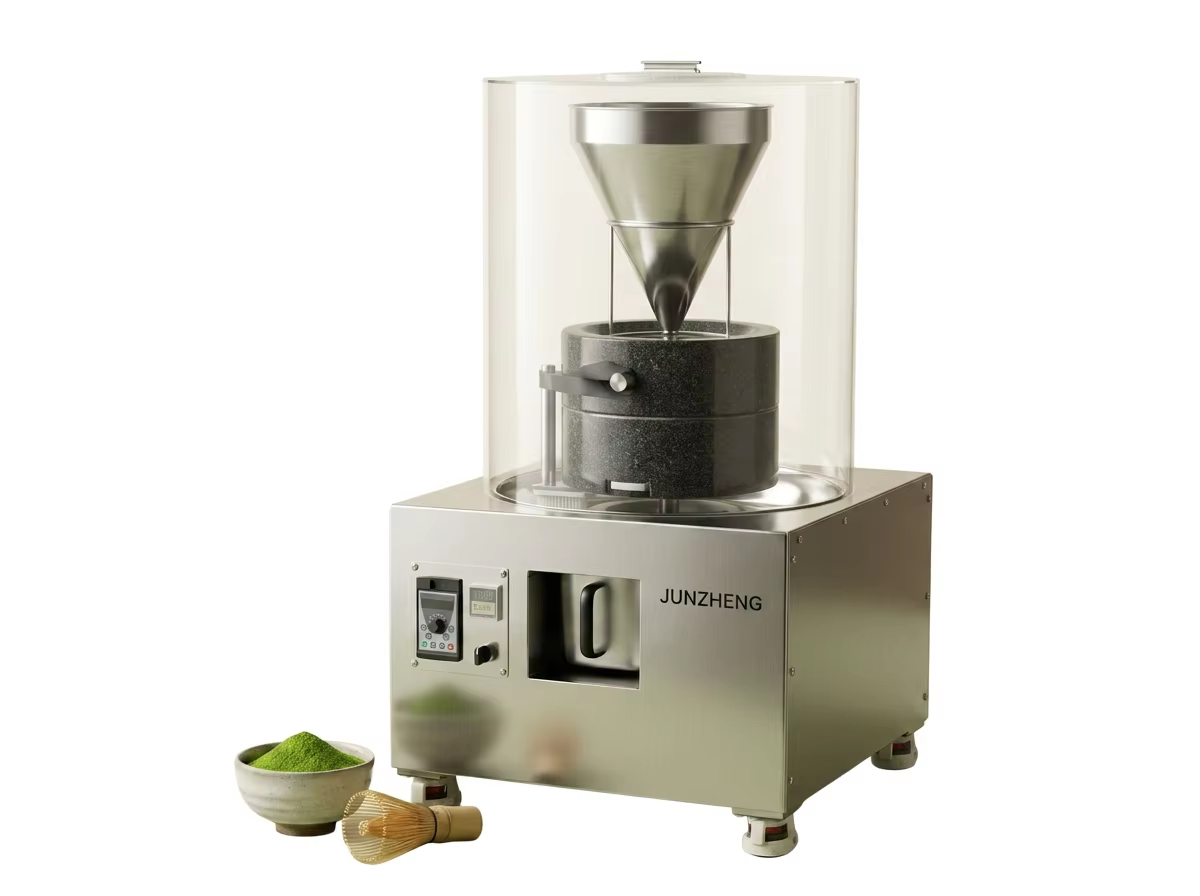
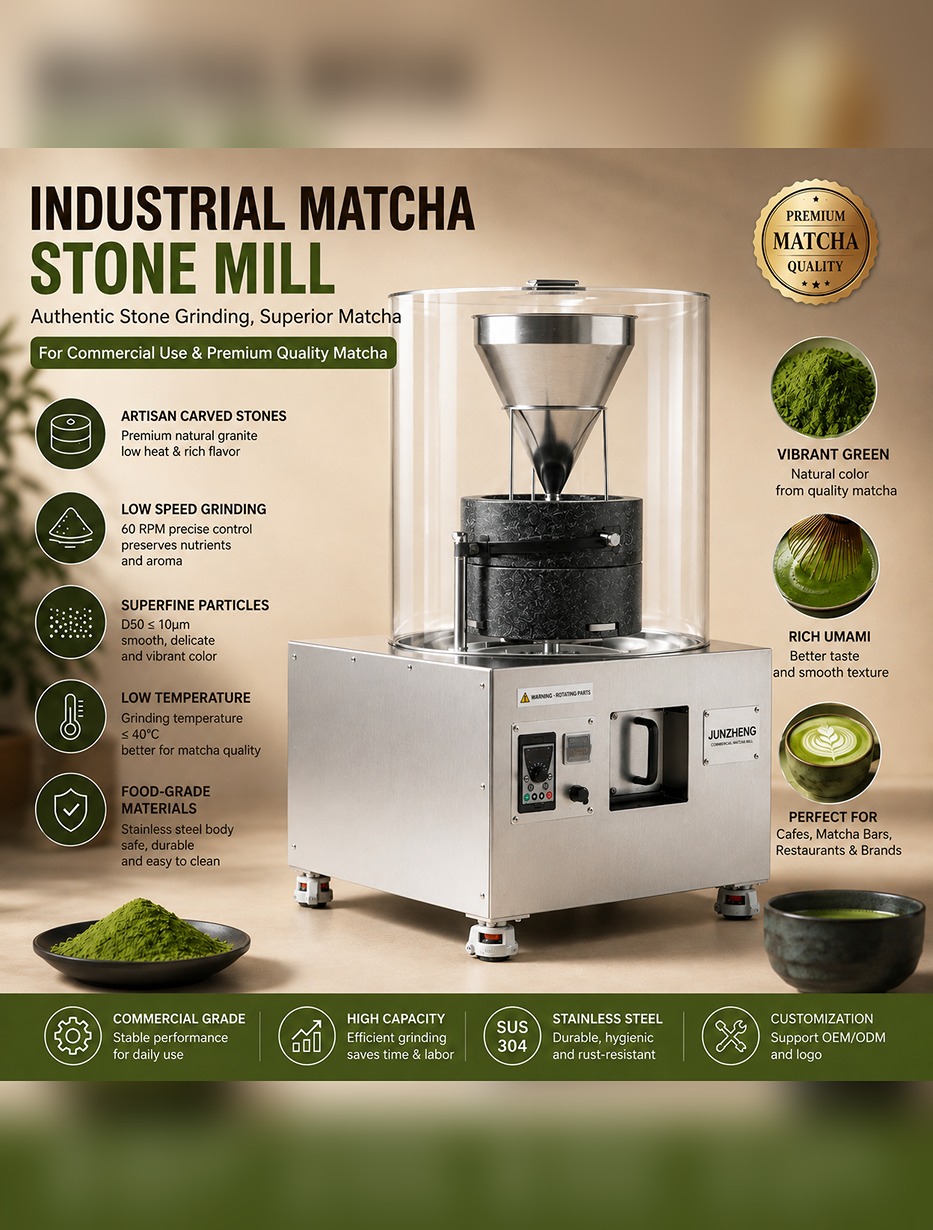
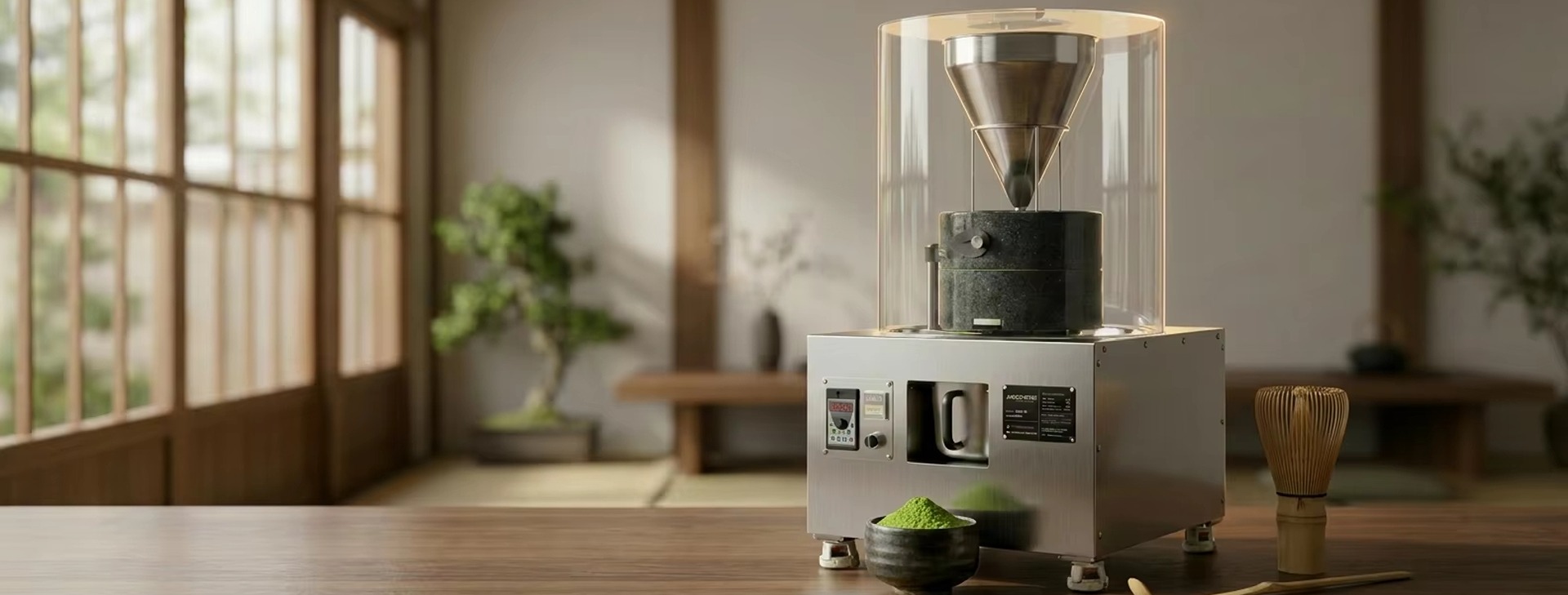
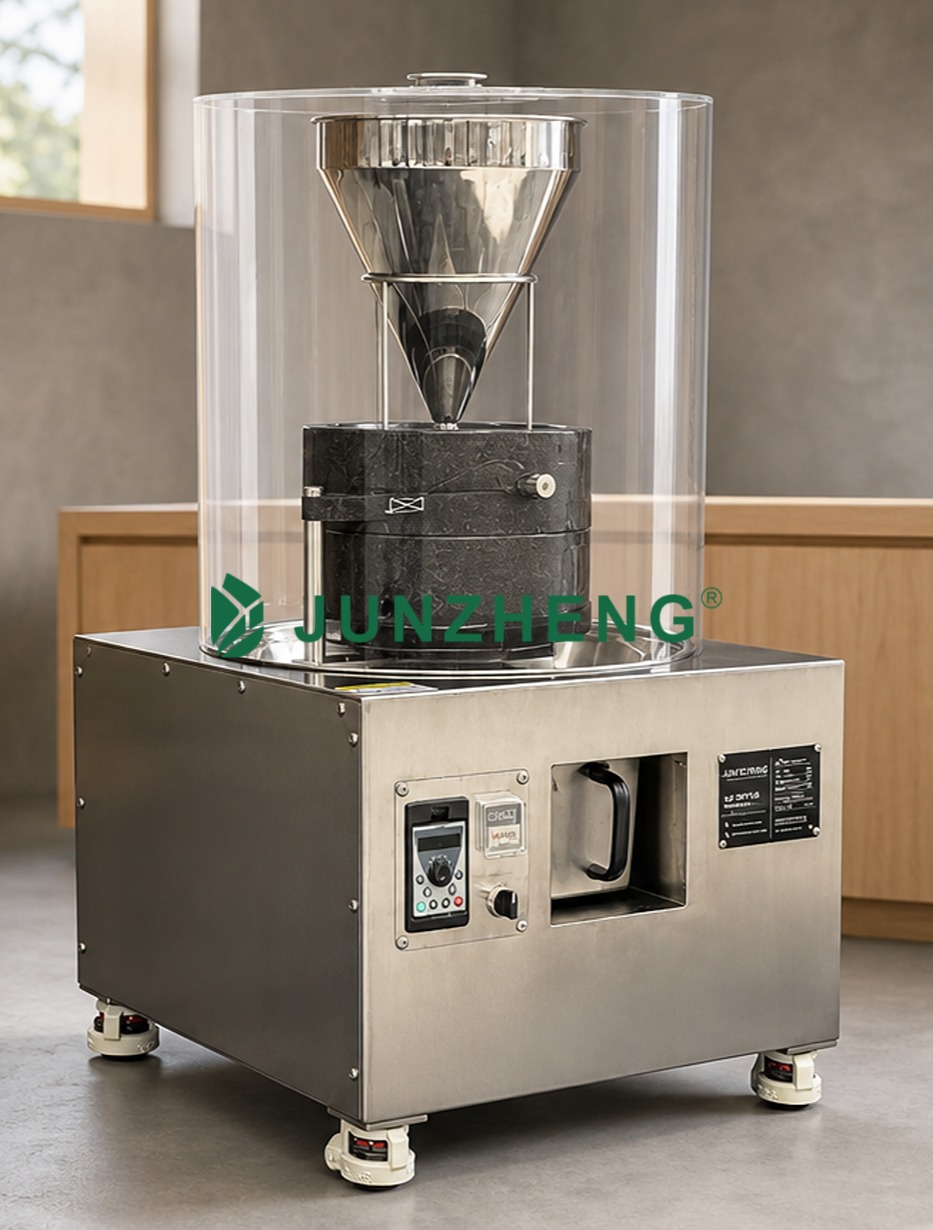
For example, the JUNZHENG JZMY06 is designed for controlled commercial matcha grinding at approximately 30–40 g/hour, rather than maximizing production speed.
This makes it more relevant to applications where controlled small-batch production and premium matcha preparation are more important than high-volume industrial pulverization.
For larger industrial applications, different milling technologies and production systems may be more appropriate.
10. Matcha Is Not Simply Green Tea Powder
This distinction is important.
The terms matcha and green tea powder are sometimes used interchangeably in global food and beverage markets, but they do not necessarily describe the same production process.
Traditional matcha production begins with specially processed tencha.
Other green tea powders may be produced from different tea materials and processed using different grinding technologies.
So the difference is not simply the color of the powder.
It can involve:
- Raw material
- Cultivation
- Shading
- Processing
- Drying
- Grinding method
- Particle size
- Intended use
Therefore, when purchasing commercial tea powder equipment, buyers should first understand exactly what type of product they are trying to produce.
11. Traditional Stone Grinding and Modern Commercial Production
Modern matcha production does not always rely exclusively on traditional stone mills.
At commercial scale, some facilities use other milling technologies such as bead mills or airflow-based grinding systems.
For example, Japan’s Ministry of Agriculture has do cumented an automated matcha production facility using bead-mill and airflow grinding technologies for higher-volume production.
This does not make one technology universally better than another.
Instead, the appropriate grinding technology depends on:
- Production scale
- Desired particle size
- Production speed
- Product positioning
- Process design
- Investment level
- Intended application
For businesses specifically seeking the traditional stone-ground approach, however, a commercial electric stone mill can provide a practical way to bring controlled stone grinding into a modern professional environment.
From Tencha to Matcha: The Complete Process
The entire process can be simplified into the following sequence:
1. Tea Cultivation
Tea plants are grown under carefully managed conditions.
↓
2. Shading
The tea plants are shaded before harvesting as part of the production process for matcha-oriented tea material.
↓
3. Harvesting
Suitable tea leaves are harvested.
↓
4. Steaming
The fresh leaves are steamed as part of the process used to prevent oxidation.
↓
5. Drying
The leaves are dried without the conventional rolling process used for many other Japanese teas.
↓
6. Tencha Processing
Stems and other unwanted material can be separated during finishing.
↓
7. Grinding
Tencha is gradually reduced into fine powder.
↓
8. Matcha
The finished fine powder becomes the matcha used for tea, beverages, desserts, and food applications.
This is why a matcha stone mill represents only one stage of a much larger production system—but it is a particularly important stage when the goal is to produce finely ground matcha using a controlled stone-grinding method.
What Does This Mean for Commercial Matcha Equipment Buyers?
Understanding the production process changes the way buyers should evaluate a matcha grinding machine.
Instead of asking only:
“How powerful is the motor?”
or
“How much does the machine cost?”
professional buyers should also ask:
What kind of matcha am I producing, and what grinding process is appropriate for it?
For cafés, tea houses, matcha brands, and small-batch processors, the priorities may include:
- Consistent grinding
- Fine powder
- Controlled operating speed
- Appropriate production capacity
- Easy operation
- Cleaning and maintenance
- Stable commercial construction
For larger tea processors, the priorities may be very different, particularly when production volume and automation become the main considerations.
The right equipment therefore depends on the complete production objective.
The Role of a Commercial Matcha Stone Mill
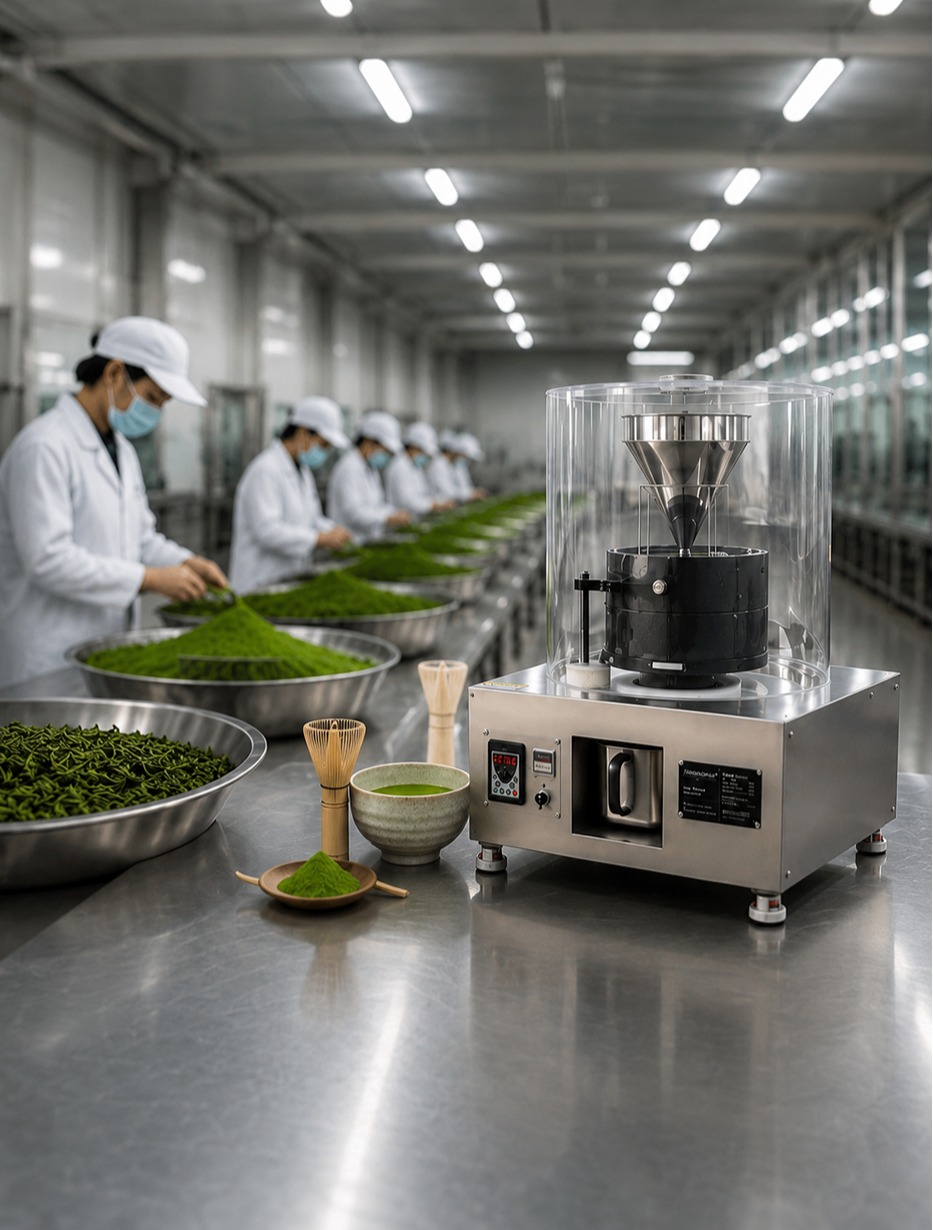
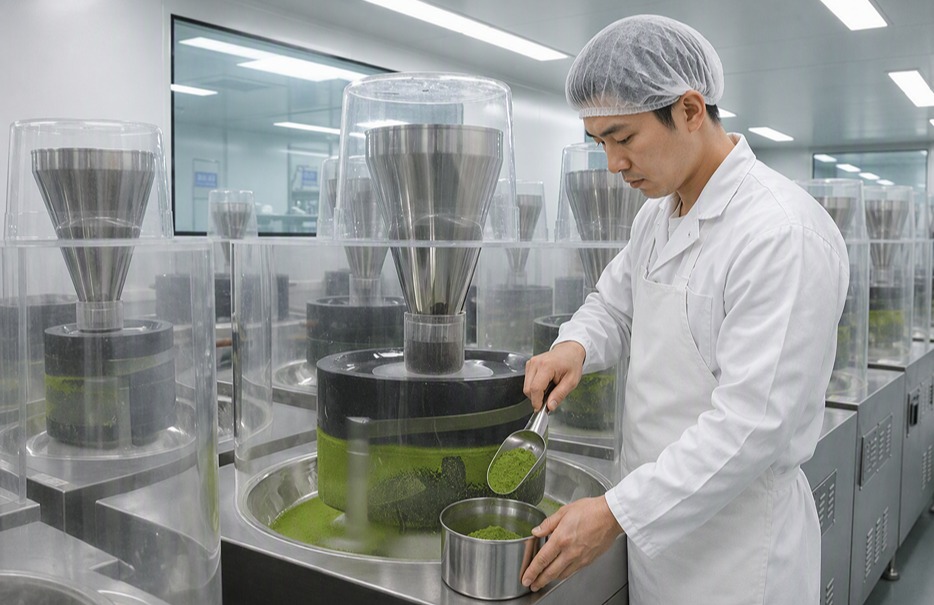
Modern commercial stone mills are designed to bring the principles of controlled stone grinding into a more practical working environment.
Instead of manually turning a traditional stone mill, operators can use an electric machine with controlled rotational speed and a commercial machine structure.
This can help make stone grinding more practical for:
- Matcha cafés
- Specialty tea shops
- Matcha brands
- Tea houses
- Small-scale processors
- Commercial beverage businesses
The key is not simply to reproduce a traditional object with a motor.
It is to combine the traditional grinding principle with reliable modern engineering.
Final Thoughts
The journey from tea plant to matcha powder involves far more than grinding.
It begins with cultivation and shading, continues through harvesting, steaming, drying, and tencha processing, and finally reaches the grinding stage where the prepared tea material is transformed into fine powder.
Understanding this process helps explain why matcha should not be treated as simply “green tea powder.”
It also explains why grinding equipment matters.
A commercial matcha stone mill does not create the quality of the tea by itself. Instead, it becomes one important part of a carefully controlled production chain that starts with the raw material and ends with the finished matcha powder.
For businesses looking to produce or prepare premium matcha, understanding the relationship between tencha, grinding method, particle size, temperature, and equipment design is the foundation for making better equipment decisions.
Explore commercial matcha stone grinding solutions with JUNZHENG, or continue learning about matcha grinding technology through our Matcha Knowledge Center.